

Autumn's Gift
Breaking the cycle of trauma

Fear, a companion too often found lurking in the shadows of our hearts. Fear of rejection, of abandonment, of being truly seen. Fear of thriving, of success. In truth, it is just fear, wearing many faces, but at its core, it is the same specter that haunts so many of us.
Autumn, with all its quiet beauty, mirrors this process of fear and transformation. As the trees shed their leaves, they show us that letting go is not a loss but a natural part of growth. In this season of transition, we are reminded that there is grace in release, that even in the sheding of what once was, there is preparation for something new.
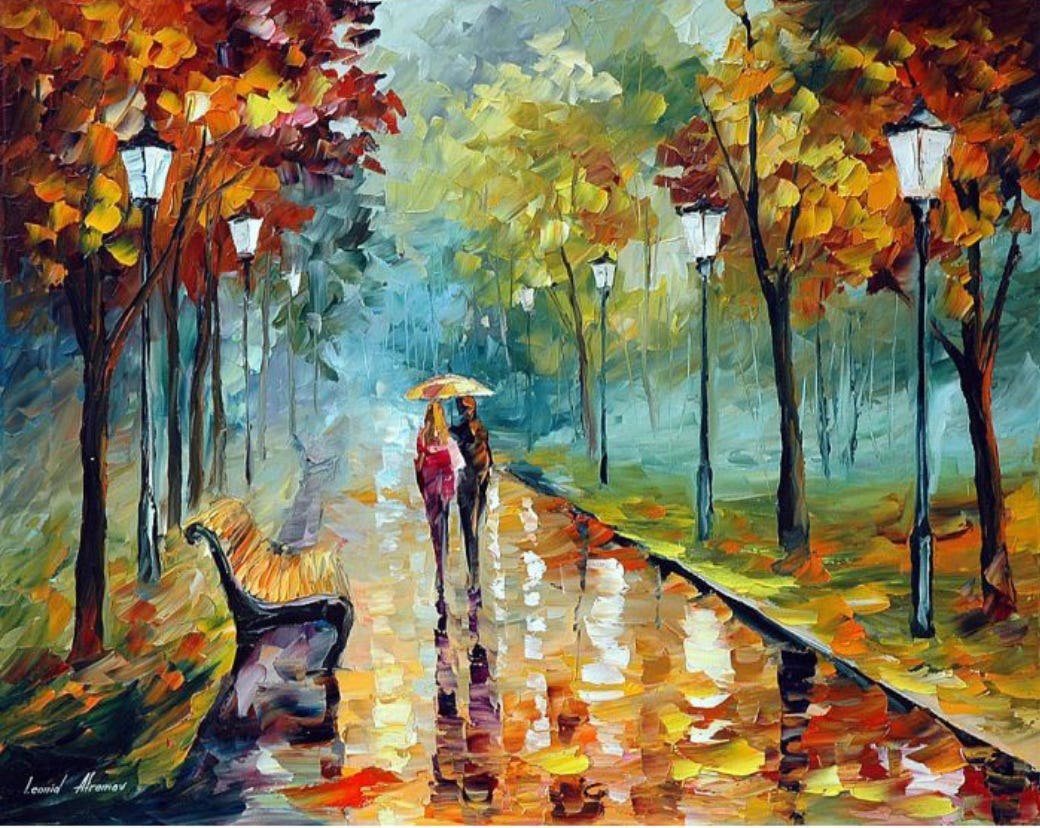
Autumn Leaves - Leonid Afremov
The weight of pleasing others, the inability to set firm boundaries, the ever-present murmur of anxiety, the relentless hum of overthinking—these, too, are like leaves clinging to us long past their season. Feelings of unworthiness, the quiet voice that tells you that you are not good enough, manifesting in unhealthy relationships or co-dependency. Perhaps it is the anxious attachment that grips you or the avoidant tendencies that cause you to withdraw. Yet, none of these burdens were yours at birth. They are the dead leaves we’ve carried from one season of life to the next, waiting for the wind of change to help us release them.
Not a single child enters this world with these traits. These are not the qualities of our true selves but of a self forged by circumstance. And so, you may wonder, how did I come to be this way?
Thanks to the revelations of psychology, trauma research, and the advancements of neuroscience, we now understand that the traits we carry as adults are the consequences of what occurred in our formative years. When our needs as children were unmet or misunderstood, we internalised these experiences, and so fear took root. Clinging to us and embedding itself within our personalities and nervous system. And as we grow, so too do these learned behaviours, shaping us into the adults we are. Though our minds and hearts still echo with the fears of our childhood.
The overreactions, the silences, the subtle jabs, or perhaps the not-so-subtle. These are not mere quirks of character or harmless traits. No, they are the coping mechanisms of those who were never taught to fully process their own pain. It is as though we have been walking through life with emotional blindfolds, each of us fumbling in the dark, doing our best with what little we were given.
Many of us were raised by parents who, though physically present, were emotionally distant. They, too, grew in a world that offered them no refuge, no space to explore the depths of their own feelings. They, in turn, were shaped by forces beyond their control—by wars, migration, political unrest, or the ceaseless demands of societal and cultural conformity. They were never asked how they felt or what they needed, and so they passed down the silence, the stoicism, the pain, because that was all they knew. Thus, the cycle continues.
This is not simply my story, nor is it solely yours. It is the story of many families. The internalised oppression that comes from generations of surviving, not thriving. Cultural trauma passed down from parents who were taught that duty and honor outweighed personal wellbeing. In their silence, they sought to shield us from the burdens they carried, but in doing so, they passed down the very pain they hoped to spare us.
Our family gatherings, brimming with stories of both triumph and hardship, are heavy with the unspoken. Behind each tale lies a weight, a tension. Our parents and their generation were not granted the luxury of healing, of processing. They were expected to endure, to be resilient, to carry the mantle of responsibility without complaint. And so, they buried their feelings deep within, coping with distraction, destructive behaviours, or substance abuse. Alcohol in particular. They did not possess the language or the tools to recognise the trauma that shaped them, and as children, we absorbed this as “normal.”
When you begin to walk the path of healing, you being to see these stories through a new lens. What once seemed like an innocently funny story now revealing itself as the echoes of unresolved trauma. Each sarcastic remark made, or tension-filled silence, is a reflection of wounds that have never been acknowledged, let alone healed.
I have learned that these patterns and dysfunction need not define us nor indeed our future. By bringing these behaviours into the light, by naming them for what they are, we begin to break the cycle. It can end with you.
For some, like myself, healing may require a distancing from the family that shaped these dynamics. I have found solace in solitude and cultivated a unique mindset that allows me to choose who I interact with and when. But this is not the path for everyone. We are all different. Some of us are social creatures, yearning for connection. In such cases, healing is not about isolation but about understanding. It is about recognising the roots of the behaviours you see in others and in yourself. It is about holding compassion for them, while you pave a new path forward for yourself.
Healing requires a reparenting of oneself. It is an act of love, of giving the younger version of you the care and support you did not always receive. You begin to unlearn the internalised oppression and cultural conditioning that told you to keep quiet, to put others first, to conform to a mould that was never meant for you. You learn to live authentically, to embrace your true self, not with shame or fear, but with pride and love. You break the cycle by rewriting the script of what it means to be part of your lineage.
I have come to understand that I am a bridge—a bridge between the generations that came before and those that will follow. My healing is not solely for myself; it is for them too. For the ancestors who were never granted the opportunity to heal, and for the future generations who will inherit something new, something different. In choosing to heal, you choose a future that is no longer tethered to the weight of the past.
This is a topic that lies at the heart of my coaching practice and one that I am deeply passionate about. I dedicate much of my time to reading, learning, and immersing myself in this work to better support my clients. As someone who has personally experienced the effects of generational trauma, I understand its profound impact. Growing up in a highly dysfunctional family shaped much of my childhood and adult life. It wasn’t until I began to break the cycle that I found true freedom. Yet, the journey of healing is ongoing—it is a continuous process of growth and transformation.
As ever, thank you for reading. Please do share your thoughts in the comments, or pass this along to someone who might appreciate the essay. And if you’re new here, I’d be delighted if you’d join my little corner of Substack. It’s free to subscribe.
Love,
H
x